Work, finance and organisations

An economy you live inside

Earn wages, finance projects, pay specialists and carry real obligations. Organisations have budgets and commitments of their own.

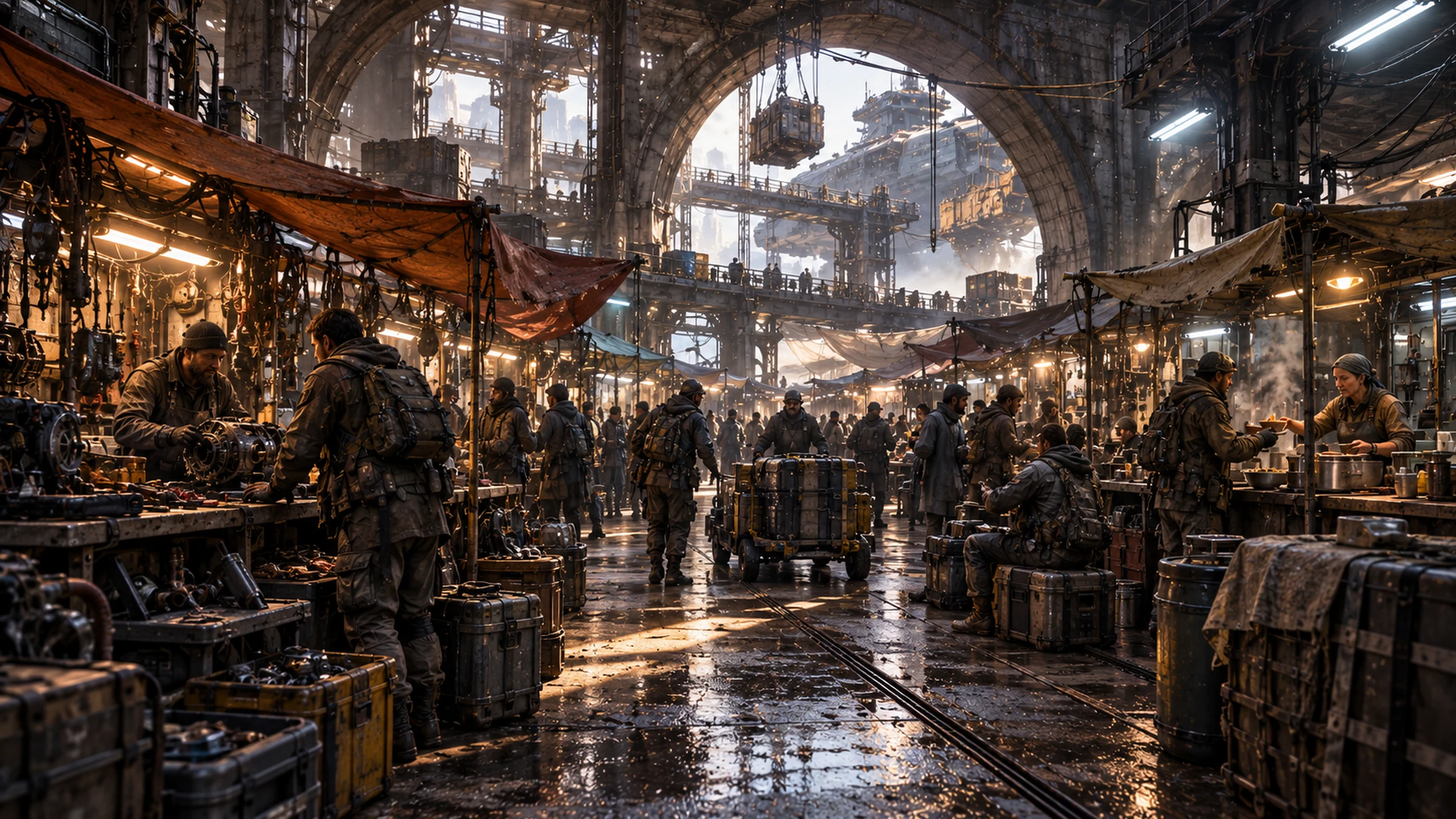
People trade components and repair equipment inside a busy industrial market.

What this means for your play

Choices with practical meaning.

Money comes from somewhere. Employers, lenders, suppliers and institutions have their own funds and limits. Your projects, losses and recovery routes operate inside that economy, rather than receiving unlimited funding from the story.

Make project funding part of planning

Loans, trade credit, issuer finance, liens and repayments can support major facilities or recovery. A lender still has exposure limits and you may need to provide your own share. A lost grant stays lost. Financing a replacement creates an obligation instead of erasing the cost of failure.

Understand supply beyond your settlement

Regional imports can offer another route around local scarcity, but they can carry higher prices, finite allocations, compatibility restrictions and real lead times. Transport still matters. A resource supplied from elsewhere does not become local stock just because you need it quickly.

In depth

How it works.

Follow the part that interests you. These systems continue to matter as your character and operation grow.

Money is part of the simulation.

  • Credits are not simply a score.
  • You can earn them.
  • Spend them.
  • Lose them.
  • Borrow them.
  • Owe them.
  • Work for them.
  • Finance major projects.
  • Carry debt.
  • Pay specialists.
  • Buy equipment.
  • Import scarce materials.
  • Lose grants.
  • Fund your own recovery after failure.
  • Organisations have their own money too.
  • They cannot endlessly fund the player.

They have their own operating needs, rewards, commitments and financial limits. Under heavy economic pressure, the player may need to work real paid shifts for organisations with available funds.

  • Those shifts consume world time.
  • They pay actual wages.
  • The money comes from the employer's real wallet.

The work does not magically award mission success, standing or qualifications. Sometimes rebuilding your finances is itself part of playing CYBERTECH.

Failure can cost more than hit points.

Major facilities and recovery routes can involve loans, trade credit, issuer finance, liens and repayment obligations. Credit is not unlimited. Affordability is not automatic. A lender has its own funds and exposure limits. The player may need to supply their own share. A lost grant remains lost. A financed replacement remains debt. CYBERTECH allows the campaign to continue without pretending failure was free.

The economy can actually run short.

CYBERTECH's organisations have their own resources and money. Under enough failure pressure, those resources can become strained.

  • Employers cannot endlessly pay wages.
  • Finance providers cannot lend without limits.
  • Organisations must preserve funds for their own commitments.

The player may need to work for different organisations as financial conditions change. Heavy campaign failure can create genuine economic pressure across the settlement. The game is expected to handle that pressure rather than generating free money to protect progression.

Local scarcity does not mean the wider world disappears.

If something is unavailable locally, legitimate regional supply may sometimes exist.

  • CYBERTECH can support premium imports with:
  • Higher prices.
  • Real lead times.
  • Finite regional allocations.
  • Transport and logistics.
  • Lineage or compatibility restrictions.

An imported resource does not become a local resource simply because it is convenient. This allows a larger functioning world without making local scarcity meaningless.

Sometimes progress means going to work.

If a player has suffered enough financial losses, CYBERTECH can require them to rebuild capital through real paid work.

  • A shift consumes world time.
  • The employer pays from its own funds.
  • The PC earns a real wage.
  • Nothing else is automatically granted.
  • No mission success.
  • No standing.
  • No free qualification.
  • No building credit.
  • Just wages for work.
  • That is part of living in the world.

Organisations have resources, obligations and limits of their own.

Corporations, colleges, councils, research bodies and other organisations are not simply unlimited mission dispensers.

  • They can have their own money.
  • Their own commitments.
  • Their own staff.
  • Their own facilities.
  • Their own standing relationships.
  • Their own operational requirements.
  • They can finance.
  • Employ.
  • Sponsor.
  • Hire specialists.
  • Import materials.
  • Perform maintenance.
  • Run out of spare money.

The player operates inside an economy rather than above it.

A concrete example

Rebuild capital through paid work

After financial losses, you take a paid shift with an organisation that can afford to employ you. The shift consumes world time and its wages come from the employer's funds. It does not grant mission success, standing or a qualification. It gives you actual money with which to plan your next step.

Executives meet a visitor across a secure corporate boardroom table.
Cybertech scene illustration: Executives meet a visitor across a secure corporate boardroom table.
An expanded Command Carrier receives new modules in a vast service dock.

Continue in VISINVOKE

One character.
A world of possibilities.

Create a free VISINVOKE account. Review CYBERTECH access in your account and begin your own continuing science-fiction journey.

Create a free VISINVOKE account